Showing posts with label helping others. Show all posts

Wednesday, May 30, 2018

Common Courtesy - Interacting with a disabled person

I remember back when I did not have any physical disabilities. I never really thought too much about some of the points made in the article below. As my Kennedy's Disease progressed, several times I found myself in a position that I needed hel. Some of the kindest people are often strangers that I met once and will probably never meet again. Regularly, I find that a single act of kindness at a moment of need is remembered for years.

The below article was published on the “How to of the Day.” To read more, please follow the link below.


How to Interact With People Who Have Disabilities


It's not uncommon to feel a bit uncertain talking to or interacting with someone who has a physical, sensory or intellectual disability. Socializing with people with disabilities need be no different from any other interactions. But, if you're not familiar with a given disability, you might fear either saying something offensive or doing the wrong thing by offering assistance. Here are some dos and don'ts to keep in mind.

1. Realize that disability is universal. Think about the friends or family members you know with disabilities. Perhaps they have arthritis or other physical limitations and are unable to walk up stairs. Perhaps they have a hearing problem, or are on a special diet due to diabetes. Disability of one kind or another is something that we all experience personally in life, eventually. Thus, we will all have times when we need a little help and understanding.

2. Learn from people in your life. If you are able to be considerate of the people you know, you will also be able to do the same for strangers. Ask the people you know how they feel, what they prefer, how they react to situations, and take your cues and lessons from them. You can use the same lessons with strangers.

3. Understand that most people with disabilities have adapted to them. Some disabilities are present from birth, and others come later in life due to accident or illness, but either way, most people learn how to adapt and take care of themselves. Most are independent in everyday living, but that does not mean they might need help at certain times.

4. When people develop disabilities later in life, it may require lots of adjusting on their part. Things that they were able to do naturally now require adaptation and patience, and there are some things they may never be able to do without assistance or assistive technology. They may need help for tasks they once did without thought. But none of this means that they can't adapt to a new way of life, and as such, while they may require your support, they do not need your pity.

5. Put yourself in their position. Don't focus on the disability. It is not important that you figure out what their particular problem is; it is only important that you treat them as an equal, talk to them as you would to anyone else, and act as you would normally act if a new person entered into your life.

6. Don't be afraid of asking what disability a person is dealing with if you feel this might help you make a situation easier for them. For example, if a person has difficulty walking, ask them if they would prefer to take the elevator instead of the stairs. Chances are, they have been asked that question a million times, and they know how to explain it in a few sentences. If the disability resulted from an accident or the person finds the information too personal, they will most likely answer that they prefer not to discuss it.

7. Ask if you can be of assistance to them, as appropriate. Never act as if you have not noticed them. Ask if you can help, but do not insist on it if they tell you they do not need help.

8. Avoid getting in the way. Move out of the way when you see someone attempting to navigate in a wheelchair. Move your feet out of the path of someone who is using a cane or a walker. If you notice that they might not be strong and steady on their feet, offer to help, but do not invade their personal space.

9. Unless asked to do so, do not touch their wheelchair or any aid device including guide, hearing or seeing-eye dog without asking.

10. Be patient. For example, if the person in front of you is slowly walking down the stairs, do not mutter under your breath or sigh deeply. Show the same kind of patience that you would want in their shoes.

11. Teach your children to be kind and understanding. Take a zero tolerance policy on laughing at someone who might look strange or funny to them. Teach them that all people have feelings, just like they do, and that they should accept their differences without judgment. It's okay for children to be curious and ask you discrete questions about disability.

12. Remember that people are, first and foremost, people. Offering help to someone with a disability should come from kindness, not a sense of pity or a perception of weakness. Seek to help others, and if you find yourself being offered help, regardless of whether you have a disability, accept it gratefully, with a smile and a thank you. Be respectful, above all else.


To read the entire article, follow this link: Interacting with People with Disabilities

Sunday, February 25, 2018

How Can I Help?


Acceptance is something I have written about several times over the years. Unfortunately, it is not a light switch that can just be turned on. It is not something that automatically means you are happy again or brings you comfort. In fact, there are still things in my life that I have not fully accepted yet.

This process of rediscovery is a never-ending journey for me. Every time I accept something new about my condition and myself, it is like another awakening. In addition, whenever I find a new way to express myself and help others, it opens another door.

Several years ago, I was watching "Saturday Night Lights." The high school football team was down 26 to zero at the end of the first half. The coach ended his halftime pep talk to his players with the following. "Every man at some point in his life is going to lose a battle. He is going to fight and he is going to lose. What makes him a man is that in the midst of the battle he does not lose himself."

Dr. Phil says it another way, "What happens in your life will affect you, but it does not have to define you."

As I travel life’s highway, I need to focus on the moment, forget about the past, and not be too concerned about the future. The only thing I have any control over is this my attitude at this moment.   


Another favorite saying of mine is, "Nothing comes into existence uninvited." If I worry about what could be, it will probably come to pass (or maybe even something worse). On the other hand, if I focus on what I can do today to make a difference for others, then the past and the future really does not matter.

So, my question for you is...


Tuesday, February 13, 2018

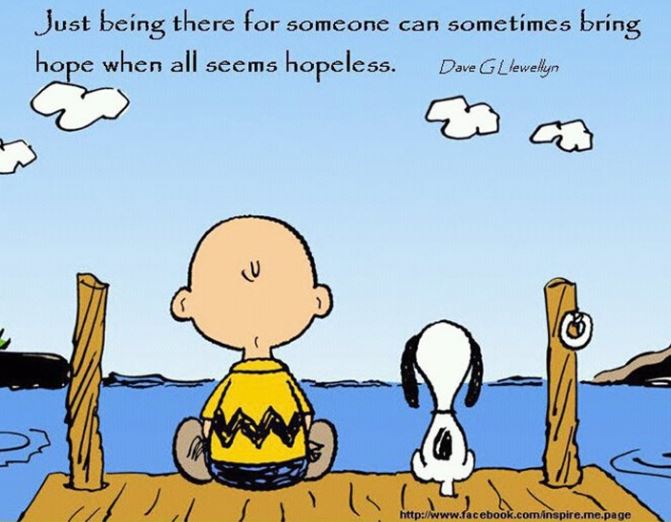
Just Be There

For those of us living with a progressive disorder, knowing we are not alone is important mentally and emotionally. 


The dictionary defines "support" as: (1) to hold up or provide a foundation, (2) provide assistance, (3) the act of helping to bear the weight or strengthening. Nowhere does this word mean, ‘to fix.’ I was always a ‘fixer’. I tried to make things better, but often found I was not helping at all. I am learning that often you just need to “be there” for others in their time of need.

My father had a gift; one that I do not possess. He could "be there for you." My dad spent a good deal of his evenings and Sunday afternoons visiting shut-ins or people in the hospital. On several occasions, I went with him to help perform some needed chores around the person's house while he or she recovered. The one thing that amazed me was my father’s ability to "be there" without intruding. Many times, he would just sit there in the room without saying a word. At other times, he would be chattier than his usual self. 

I asked him one time how he could just sit in a room with a person for over an hour and not say anything. He responded, "You do not always have to talk to carry on a conversation." At the time I did not have a clue what that meant. 

He also told me that often a person, especially someone with a serious illness, does not want to talk about it. They just want to know that you are there and praying for them. He felt you never really knew what was going to happen when you visited someone. It was important that you not try to say the right words, try to help, or try to carry on a conversation. It is your job to be there for them in whatever role they need at the time. He surprised me when he added, “Sometimes that means you are the punching bag.”

Many a time I saw him sitting next to someone's bed and holding his or her hand. Other times, I saw him kneel next to the person's bed and pray. Often, I saw him crying afterwards. One time after we left a person's house that was dying of cancer, I asked why he does this if it tears him up so bad. He said, "Because they need to know they are not alone."

When I then asked him how he knows what to say, he commented, “I don’t know what to say until I sit with the person. I just have faith that the right words would be there when needed.”

He also mentioned something that hit home much later in my life. "Never say that you know what a person is going through, because you don't. Be there for them. Let them take the lead. And, be patient."