Showing posts with label Kennedys Disease Research. Show all posts

Monday, September 17, 2018

Research Proves My Wife Wrong


For several years, my wife has told me, “You’re getting dumber every day.” She follows it up with something like, “I don’t know if it is the Kennedy’s Disease or what, but…”

Well, researchers have proven her wrong ‘once again’, and I love it. 😊

Nature.Com published in September the results of a study of patients with Spinal Bulbar Muscular Atrophy. Click on the link below to read the entire study.

UnimpairedNeuropsychological Performance and Enhanced Memory Recall in Patients with SBMA:A Large Sample Comparative Study

Abstract:

“Peculiar cognitive profile of patients with SBMA has been described by fragmented literature. Our retrospective study reports the neuropsychological evaluations of a large cohort of patients in order to contribute towards the understanding of this field. We consider 64 neuropsychological evaluations assessing mnesic, linguistic and executive functions collected from 2013 to 2015 in patients attending at Motor Neuron Disease Centre of University of Padova (Italy)…”

“…the aim of the present study is to report the neuropsychological evaluation of a large sample of SMBA patients in order to contribute towards the definition of these patients’ cognitive profile.”

“…administered brief neuropsychological battery aimed to a fast evaluation of short- and long-term memory, linguistic abilities and executive functioning (for details please see methodological section). The tasks’ choice had a clinical finality and was aimed to assess the integrity of the cognitive functions in order to eventually consider hinderances to an adequate communication with the doctor, or that could undermine patients’ compliance in the home management of care…”

Results:

Neuropsychological findings - “ANCOVA results showed no statistically significant difference between groups in all the examined test performance, except for the Babcock Story Recall Test score, in which patients performed better than control participants, with no relevant influence of age and education. Education level was instead a statistically significant covariate for all the other measures, while participants’ age was found statistically significant for the TMT B-A and the DSf scores only…”

Discussion – “No frank cognitive impairment was found in our retrospective study on 64 patients with SBMA, as deduced from the scores of patients on neuropsychological tests, compared with those of healthy male subjects. Surprisingly, patients showed better performance on the Prose Memory test score…”

“…This interpretation nicely fits with the phenomenon of the so called somatic mosaicism, characterizing this pathology. It implies that the number of CAG-repeats is not constant in every cell of an individual, but it may vary across tissues, including the cerebral ones; such an instability is typical of other neuromuscular diseases…”

Full Disclosure:  My ‘wonderful’ wife never said those things. She has questioned my intelligence, however, when I do something dumb and end up falling.

A Special Thank you:  Istvan Reinhardt sent me the link to the above study.

Friday, March 16, 2018

Study identifies potential drug for treatment of debilitating inherited neurological disease

The following is an excerpt from a Medical Press article. To read the entire article follow this link: Potential Drug Treatment

March 15, 2018

Dr. Paul Taylor of St. Jude Children's Research Hospital ...
"... and his colleagues were led to seek drugs to treat SBMA because of findings from a previous study in his laboratory. The study pinpointed a molecular niche in the mutant androgen receptor protein that appeared to be a key to driving SBMA symptoms. However, that niche did not seem to be essential to the normal function of the androgen receptor. The study started with fruit flies genetically engineered to have the human androgen receptor, giving the scientists a living "test tube" to explore the effects of mutating the receptor.

"This identification of a small patch of this protein that appeared to be functionally important for driving the disease, but is not essential for most androgen receptor functions, gave us a potential drug target," Taylor said.

Pharmaceutical companies have been developing drugs to target this small patch, called the "activator function-2" or "AF2" domain. The companies were testing the drugs as possible treatments for prostate cancer, which also involves the androgen receptor. Taylor obtained a collection of the test drugs to evaluate for use with SBMA.

Using the genetically engineered flies, the researchers identified two drugs—whose long chemical names are abbreviated TA and MEPB—that alleviated SBMA symptoms. Then, using mice, the scientists determined that MEPB more effectively reached target tissues in the brain and spinal cord.

For their trials of TA and MEPB as potential SBMA treatments, the researchers developed a new genetically engineered mouse model to more accurately mimic the mutation found in men with SBMA. The transgenic mice showed many of the symptoms of humans with the disease.

Researchers found that MEPB effectively alleviated symptoms of SBMA in the mice. "Treating the mice with MEPB forestalled muscle atrophy and prevented loss of their motor neurons, with recovery of their testicles to normal size," Taylor said. "The treatment also protected their ability to walk and their muscle strength and endurance." ..."

Wednesday, July 12, 2017

Autophagy - akin to a garbage disposal system

I thought I published an article on this study, but cannot find it. So, here it is.

Target Identified For Rare Inherited Neurological Disease

Scientists show bad androgen receptor impairs body’s ability to dispose of damaged cells

Researchers at University of California, San Diego School of Medicine have identified the mechanism by which a rare, inherited neurodegenerative disease causes often crippling muscle weakness in men, in addition to reduced fertility.

The study, published August 10 in the journal Nature Neuroscience, shows that a gene mutation long recognized as a key to the development of Kennedy’s disease impairs the body’s ability to degrade, remove and recycle clumps of “trash” proteins that may otherwise build up on neurons, progressively impairing their ability to control muscle contraction. This mechanism, called autophagy, is akin to a garbage disposal system and is the only way for the body to purge itself of non-working, misshapen trash proteins.

“We’ve known since the mid-1990s that Alzheimer's disease, Parkinson's disease and Huntington's disease are caused by the accumulation of misfolded proteins that should have been degraded, but cannot be turned over,” said senior author Albert La Spada, MD, PhD and professor of pediatrics, cellular and molecular medicine, and neurosciences. “The value of this study is that it identifies a target for halting the progression of protein build-up, not just in this rare disease, but in many other diseases that are associated with impaired autophagy pathway function.” ...

... “Our study tells us that if we can find a way to keep TFEB working, we likely can prevent this disease and others like it from progressing,” La Spada said. “We now have a target for new therapies to treat not only Kennedy's disease, but also many more common neurological disorders.”

Follow this link to read the entire article: UC San Diego News

Friday, November 25, 2016

SBMA Study published regarding the AR113Q Muscle

This research paper was published a month ago.

Rescue of metabolic alterations in AR113Q skeletal muscle by peripheral androgen receptor gene silencing

Elisa Giorgetti, Zhigang Yu, Jason P. Chua, Ryosuke Shimamura, Lili Zhao, Fan Zhu, Sriram Venneti, Maria Pennuto, Yuanfang Guan, Gene Hung, and Andrew P. Lieberman1,


Highlights

•Decreased expression of carbohydrate metabolic genes characterizes AR113Q muscle
•AR113Q skeletal muscle shows decreased glycolysis and altered mitochondria
•Peripheral gene silencing by ASO rescues expression of muscle energy metabolism genes
•Altered muscle energy utilization contributes to non-neuronal disease manifestations


Summary

Spinal and bulbar muscular atrophy (SBMA), a progressive degenerative disorder, is caused by a CAG/glutamine expansion in the androgen receptor (polyQ AR). Recent studies demonstrate that skeletal muscle is an important site of toxicity that contributes to the SBMA phenotype. Here, we sought to identify critical pathways altered in muscle that underlie disease manifestations in AR113Q mice. This led to the unanticipated identification of gene expression changes affecting regulators of carbohydrate metabolism, similar to those triggered by denervation. AR113Q muscle exhibits diminished glycolysis, altered mitochondria, and an impaired response to exercise. Strikingly, the expression of genes regulating muscle energy metabolism is rescued following peripheral polyQ AR gene silencing by antisense oligonucleotides (ASO), a therapeutic strategy that alleviates disease. Our data establish the occurrence of a metabolic imbalance in SBMA muscle triggered by peripheral expression of the polyQ AR and indicate that alterations in energy utilization contribute to non-neuronal disease manifestations.

Wednesday, November 23, 2016

I love Thanksgiving

Thanksgiving is an important time of year for me. It is a time when our family gets together to 'break bread' and share our thoughts. Once everyone sits down, and we all hold hands to pray, sighs can be heard around the table. At that moment, everything is all right.

It is easy to focus on the negative things, but Thanksgiving gives us an opportunity to say THANK YOU for all the good–for all the blessings in our lives.

Today, I am thankful for …
  • The men and women of our armed forces, and their families. They sacrifice so much without adequate appreciation, compensation or reward.
  • For the fire, rescue and police men and women who are there for us in time of need.
  • Being able to live in this country. We often complain about what is wrong, but we seldom say thank you for all that is right. I would not want to live anywhere else.
  • The doctors and researchers who are searching for a treatment or cure. I have said it before, but without them there would be no hope.
  • My wonderful, thoughtful, patient, understanding and beautiful wife. She makes life worth living every day.
  • Both of our families, as well as our friends and neighbors. These people are my support system. Life without family and friends would be pretty miserable and boring.
  • My overall health and the health of our families. Too often we take this for granted until something bad happens.


From our house to yours, have a safe, 
healthy and happy Thanksgiving

Photos from Littlethings.com, wikipedia,and wikimedia 

Thursday, September 1, 2016

New key in fighting Kennedy's disease - Revisited

This is the same study as reported in an earlier post, but I believe the Science Daily’s writing is more generic and easier understood.


_______________________________
If a disease affects motoneurons, cells that control voluntary muscle activity, researchers should focus their efforts on motoneurons to find potential treatments, right?
Not always.
In new research led by Michigan State University and published in the current issue of Human Molecular Genetics, scientists have found a new target, which could lead to future treatments for Kennedy's disease. The disease, also known as spinal bulbar muscular atrophy, affects only men later in life and robs them of the capacity to walk, run, chew and swallow.
Researchers of motoneuron disease typically have focused on how bad genes in the motoneurons cause them to become sick and die. It was presumed that the disease, which causes severe and progressive muscle wasting and weakness, is being driven by a loss of connections with dying neurons in the spinal cord.
"We now believe the opposite is true," said Cynthia Jordan, MSU neuroscientist and senior author of the paper. "We think that the bad gene in the muscle is the culprit -- that it works backwards to inflict damage on the motoneurons." …

To read the entire article, follow this link:  New keyin fighting Kennedy's disease

Tuesday, April 22, 2014

Mutant Protein in Muscle Linked to Neuromuscular Disorder

A press release from U.C. – San Diego provides a new glimmer of hope in determining the cause and possible treatment of Kennedy’s Disease (SBMA).  The actual link to the article is: 
http://health.ucsd.edu/news/releases/Pages/2014-04-16-mutant-protein-linked-to-sbma.aspx

An excerpt of the article is shown below: 
A new therapeutic target for Kennedy’s disease and a potential treatment  
UCSanDiego-MouseModel
In the new paper, a team led by principal investigator Albert La Spada, MD, PhD, professor of pediatrics, cellular and molecular medicine, and neurosciences, and the associate director of the Institute for Genomic Medicine at UC San Diego, propose a different therapeutic target. After creating a new mouse model of SBMA, they discovered that skeletal muscle was the site of mutant protein toxicity and that measures which mitigated the protein’s influence in muscle suppressed symptoms of SBMA in treated mice, such as weight loss and progressive weakness, and increased survival.    
 
In a related paper, published in the April 16, 2014 online issue of Cell Reports, La Spada and colleagues describe a potential treatment for SBMA. Currently, there is none.
 
The scientists developed antisense oligonucleotides – sequences of synthesized genetic material – that suppressed androgen receptor (AR) gene expression in peripheral tissues, but not in the central nervous system. Mutations in the AR gene are the cause of SBMA, a discovery that La Spada made more than 20 years ago while a MD-PhD student. 
 
La Spada said that antisense therapy helped mice modeling SBMA to recover lost muscle weight and strength and extended survival.  
 
“The main points of these papers is that we have identified both a genetic cure and a drug cure for SBMA – at least in mice. The goal now is to further develop and refine these ideas so that we can ultimately test them in people,” La Spada said.


Saturday, February 15, 2014

New clinical trial for Kennedy’s Disease

NIH

The National Institutes of Health (NIH) posted the following on their ‘Clinical Trials’ website.

Safety, Tolerability, and Efficacy of BVS857 in Patients With Spinal and Bulbar Muscular Atrophy

It appears this is a two part placebo-controlled study to determine dosage and potential safety issues as well as the any change in thigh muscle volume. The trial is to begin this month.  

I will post more information as it becomes available.


Friday, October 18, 2013

Kennedy’s Disease Research

researcherOver the last few years I have written several articles about research and research related to Kennedy’s Disease.  Below are links to several of these articles.  In late November, I hope to have some updates on current research that was reported upon at the annual conference of the Kennedy’s Disease Association being held in early November.

Thursday, August 22, 2013

Kennedy’s Disease Research Grant

The MDA announced today that they awarded a research grant to Dr. La Spada to further study the what happens to the process of autophagy for those of us with Kennedy’s Disease. The following two articles are found on the MDA website.
-

Spinal-bulbar muscular atrophy (SBMA)

Two studies, both at the University of California, San Diego, examine the important role of protein recycling in SBMA. Cells rely on a process called autophagy (awe-TOF-uh-gee) to break down and recycle large proteins and subcellular structures. Autophagy is critical for cell health, but relatively little is known about the process in motor neurons, the muscle-controlling nerve cells that are affected in SBMA and other diseases, including ALS and SMA.

In SBMA, proteins misfold and accumulate in motor neurons. Autophagy should take care of these accumulated proteins before they cause problems, but the process appears to be disrupted in SBMA. The goal of both projects is to learn more about the regulators of autophagy in motor neurons and how that regulation goes awry in SBMA.

Insights from these studies will likely benefit work in ALS, in which misfolded proteins also accumulate.

(Additional information can be found below)
 

SBMA — Albert La Spada, M.D., Ph.D.

clip_image002

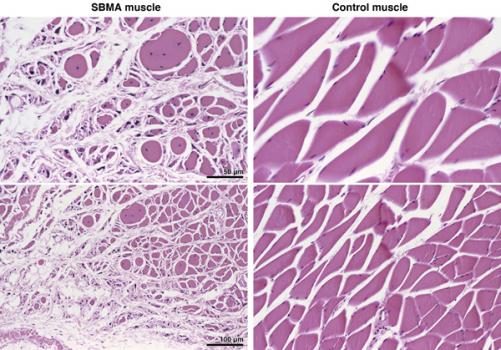
Muscles atrophy in SBMA and are a target for treatments that ultimately rescue motor neurons.
Spinal-Bulbar Muscular Atrophy (SBMA)

Albert La Spada, professor of cellular and molecular medicine, neurosciences and pediatrics at the University of California, San Diego, was awarded an MDA research grant totaling $300,000 over a period of three years to study the causes of neurodegeneration (loss of nerve cells) in spinal-bulbar muscular atrophy (SBMA).

SBMA, also known as Kennedy disease, is an adult-onset neuromuscular disorder affecting men. It is caused by a mutation in the gene for the androgen receptor protein, and it leads to the death of motor neurons, which are needed to control muscle contraction.

La Spada has created a mouse model and neuronal cell culture models of SBMA. He will now use these models to investigate how the SBMA-causing mutation leads to the death of motor neurons, focusing on changes in metabolism and impaired degradation of worn-out or defective proteins.
La Spada’s lab will test drugs that target a proposed regulatory factor and also will see whether blocking the erroneous androgen receptor gene instructions with compounds known as antisense oligonucleotides is beneficial. In previous work funded by MDA, La Spada’s lab has shown that directing therapies to muscle cells, rather than directly to the nerve cells that die in SBMA, can prevent the disease in mice.

“This exciting and unexpected finding represents an important step toward successful therapy development, as treatments that target muscle [instead of nerve cells] should be more straightforward to create, easier to test in patients and less likely to cause serious side effects,” La Spada says. “This key finding also suggests that a similar strategy is worth considering for related motor neuron diseases, such as spinal muscular atrophy (SMA) and amyotrophic lateral sclerosis (ALS).”

Funding for this MDA grant began August 1, 2013.

Tuesday, March 26, 2013

Government Funding for NMD Research

Below is an article from the MDA’s Quest Magazine on government funding for neuromuscular disease research for 2013. 
Research-2

Government Funding for NMD Research Largely Spared in Continuing Resolution

The congressional funding bill spared government programs that sponsor neuromuscular research, but it doesn't protect them from upcoming deep sequester cuts.
Article Highlights:
  • Government programs that fund neuromuscular disease research fared well in the recent continuing resolution passed by Congress on March 21. The continuing resolution funds the government through the end of September 2013.
  • Neuromuscular disease research is sponsored by several government agencies, including the National Institutes of Health, U.S. Food and Drug Administration, Centers for Disease Control and Prevention, and Department of Defense.
  • The continuing resolution does not avert pending cuts caused by the sequester. MDA’s advocacy program “will continue to work to ensure that congressional appropriators understand the importance of this life-altering work … as decisions are being made about funding for fiscal year 2014.”
by Quest Staff on March 25, 2013 - 12:27pm

The news is generally favorable for many important government-funded neuromuscular disease research projects, in the wake of Congress’ recent passage of a continuing resolution funding the government through the end of September.

Most government operations, except those funded through the full-year appropriations bills, will be maintained at essentially the same level as fiscal year (FY) 2012. (The government's fiscal year begins on Oct. 1 and ends on Sept. 30 of the following year.)

Neuromuscular disease research projects are spread across several governmental agencies, including the National Institutes of Health (NIH); the Food and Drug Administration (FDA); the Centers for Disease Control and Prevention (CDC); and the Department of Defense (DOD).
  • NIH and FDA: Both agencies received slight funding increases in the continuing resolution bill. These agencies fund basic, clinical and translational research into neuromuscular disease, as well as oversee the approval of new drugs, biologic products and medical devices.
  • CDC: The funding bill maintained last year’s funding level for the CDC. This agency implements the muscular dystrophy program through the CDC National Center on Birth Defects and Developmental Disability (NCBDD), established by the MD CARE Act and the National ALS Registry at the CDC Agency for Toxic Substances and Disease Registries (ATSDR), established by the ALS Registry Act.
  • DOD: One of the full-year appropriations bills to be included in the continuing resolution was funding for the DOD. Congress directed that FY2013 funding for amyotrophic lateral sclerosis (ALS) research be slightly increased and that funding be maintained at its current level for Duchenne muscular dystrophy (DMD). In fiscal year 2012, DOD funding for ALS research was $6.4 million, which will increase to $7.5 million in FY2013, and DMD funding held steady at $3.2 million.
“MDA is pleased that this congressional funding bill will continue to allow for the progression of vital research and critical therapy development,” said Annie Kennedy, MDA senior vice president for advocacy.

"Halting our discovery momentum at such a promising time by reducing federal scientific funding would be a ‘worst-case’ scenario. And since that potential still exists, we are continuing to work to ensure that congressional appropriators understand the importance of the life-altering work being funded by the NIH, FDA, CDC and DOD as decisions are being made about funding for fiscal year 2014.”

Kennedy noted that the continuing resolution does not avert the pending deep federal budget cuts known as the "sequester," although it does give more leeway to agencies in deciding how to make those cuts.

MDA is working with Representatives Ed Markey (D-Mass.) and David McKinley (R-W.Va.), and a coalition of national patient advocacy organizations to convince Congress to give full funding to medical research in the next fiscal year.

“Raise your voice,” urged Kennedy. “Tell Congress to provide full funding to vitally important research in 2014!”

Thursday, February 7, 2013

Oh boy, let’s eat some Soy!

Ed Meyertholen, Ph.D., our new KDA President KDA wrote the following report on a recent study. These are Ed’s comments on the research report including the potential viability of the treatment for those of us living with Kennedy's Disease.
_________________________________

Genistein, a natural product derived from soybeans, ameliorates polyglutamine-mediated motor neuron disease.
 
Research Report from Sobue’s group in Japan

soybeansEssentially, genistein is a substance found in soy and may be able to reduce the symptoms of Kennedy's Disease (KD).  This is due to the property of genistein to disrupt the association of the androgen receptor with another protein known as ARA70.  This allows the cell to remove the AR more efficiently and this, it is argued, may help relieve symptoms of KD (aka SBMA or Spinal Bulbar Muscular Atrophy).

The group did two major sets of experiments, one in cell models and one in a mouse model of KD. 

The results suggest that genistein reduces the symptoms of KD. 

Now, before we all rush out to buy soy products, understand that:
  • Mice were treated with genistein at 6 weeks, two weeks BEFORE symptoms were found to be expressed in untreated KD mice.  They did NOT test genistein in mice that already were showing symptoms.
  • The genestein did not eliminate the symptoms, it did seem to slow down the progression.  Also, it is not known if it would slow down progression after the onset of symptoms – as stated previously, this experiment was not done.  It is very unlikely that it would reverse symptoms that have already occurred.
  • The dose of genestein in the study used was 250 mg/kg/day of mouse.  This would mean a typical 70 kg (155 lb.) man would have to ingest 250*70 = 17500 mg of genistein/day.  From what I could find, soy powder has the highest concentration of genestein of all soy products; it has a concentration of 1 mg/g of soy powder.  Thus, to take in the same amount of genestein as the mice in this experiment, one would have to eat 17500 g of soy power per day – this is about 38 pounds!  You cannot eat enough soy powder daily to get the small change in symptoms seen in the mice.  If one buys the ‘purified’ (it is really just enriched) genistein, it comes in 1g tablets – one would have to take more than 17 every day – and the safe recommended dose is 2 tablets/day.   Genistein has side effects – talk to your doctor!
  • Just because genistein shows positive effects in mice does not mean it will have that effect in humans.
Conclusion: More work needs to be done before getting excited and wasting money on genistein.


Tuesday, August 21, 2012

New Funding for Kennedy’s Disease Research

The MDA announced today that they are providing funds for Kennedy’s Disease research. The recipient is Dr. Andrew Lieberman of the University of Michigan.

Dr. Lieberman is a member of the Scientific Review Board of the Kennedy’s Disease Association (KDA).  He also supports the KDA and me personally in many ways.

Andy, congratulations!
 
The MDA announcement is shown below:

Dr-Lieberman

Andrew Lieberman, M.D., Ph.D.
University of Michigan

Lieberman and colleagues have identified a small molecule in cell models and in research mice that may help degrade the mutant protein that underlies SMBA and reduce the severity of the disease in people. Click to enlarge.
 
Andrew Lieberman, assistant professor of pathology at the University of Michigan Medical School in Ann Arbor, was awarded an MDA research grant totaling $405,000 over three years to study a new therapy approach for spinal-bulbar muscular atrophy (SBMA).
 
SBMA is an inherited degenerative disorder of lower motor neurons (nerve cells) that is caused by a mutation in the androgen receptor (AR) gene. The mutant protein causes toxicity associated with the male hormone testosterone, resulting in muscle weakness and atrophy in men.
 
Previous work established that the mutant AR protein is the cause of this toxicity, suggesting that strategies aimed at more efficient degradation of the protein should diminish disease severity.
Lieberman and colleagues found that degradation of the AR protein is tightly controlled by cellular machinery consisting of the heat shock protein 70 (Hsp70).
 
The investigators now are testing genetic and pharmacologic (drug-related) methods to see whether increasing the stability of Hsp70 will help it more efficiently bind the mutant AR protein and promote its degradation.
 
“It is our expectation that this work will help define a new therapeutic approach to SBMA and other protein aggregation disorders where degradation of the mutant protein is controlled by Hsp70,” Lieberman said.
 
Funding for this MDA grant began Aug. 1, 2012.

Sunday, July 15, 2012

The role of technology in research

MDA’s Quest Magazine had an interesting article by Richard Robinson this month. “Seeing is Understanding” is about the use of Magnetic Resonance Imaging (MRI) to illuminate muscle and nerve to speed research and aid clinical trials.

The article states that “for neuromuscular disease researchers, new developments in imaging muscles and nerves are bringing new understanding of both healthy tissue and disease processes. These imaging techniques are allowing researchers for the first time to look deep within the body to track disease and to monitor the response the response to new therapies. They also have the potential to reduce the need for uncomfortable biopsies, to increase the speed and accuracy of diagnosis, and even to reduce the number of animals needed to conduct neuromuscular disease research.”

MRI

The advantages of using an MRI are discussed in the article.
  1. Versus a biopsy, it provides an image of the entire muscle. With a biopsy, there is no guarantee that the tiny portion sampled will adequately represent the entire muscle.
  2. Imaging can be done quite often. This becomes an advantage when studying a progressive disorder.
  3. Imaging may provide important clinical information much earlier … before measurable weakness is observed. An MRI can detect muscle changes before doctors can see a change of function.
  4. A MRI makes it possible to look at multiple muscles simultaneously. Since the disease may progress more aggressively in one muscle group, the ability to capture change in several areas means a more accurate picture of the entire body. It also offers a better opportunity to see if there is a response to therapy in one area versus another.
  5. Imaging may be the best way to test therapies with a small number of patients. The benefit here is determining whether anything is beneficial to a small number of patients without having the burden and expense of a full clinical trial.
And, one advantage for animal lovers is that there should be a need for fewer animals. Normally there is a need to study large numbers of mice (mouse models) to compensate for individual variations. Whole-body imaging in live mice avoids this problem because researchers can see the entire muscular system. And, best of all, imaging can be done without sacrificing the animal which often has to be done by other current methods.

The article ends by comments that ten years ago the technology was very primitive. Each year speed and technology improves meaning usage and advancements will also accelerate.

Sunday, July 8, 2012

A research update

The other day another research paper was published. Below is the abstract from the report. I have not read the entire report, but it appears to be a continuation of an earlier paper published on “The Natural History of SBMA.” I have asked our resident biology professor to provide his insight and will publish his comments should they possibly be of interest.

researcher

Longitudinal changes of outcome measures in spinal and bulbar muscular atrophy

Atsushi Hashizume, Masahisa Katsuno, Haruhiko Banno, Keisuke Suzuki, Noriaki Suga, Tomoo Mano, Naoki Atsuta, Hiroaki Oe, Hirohisa Watanabe, Fumiaki Tanaka and Gen Sobue
Published: July 06. 2012

Spinal and bulbar muscular atrophy is an adult-onset, hereditary motor neuron disease caused by the expansion of a trinucleotide CAG repeat within the gene encoding the androgen receptor. To date, several agents have been shown to prevent or slow disease progression in animal models of this disease. For the translational research of these agents, it is necessary to perform the detailed analysis of natural history with quantitative outcome measures and to establish sensitive and validated disease-specific endpoints in the clinical trials. To this end, we performed a prospective observation of disease progression over 3 years in 34 genetically confirmed Japanese patients with spinal and bulbar muscular atrophy by using quantitative outcome measures, including functional and blood parameters.

The baseline evaluation revealed that CAG repeat length in the androgenNatural History receptor gene correlated not only with the age of onset but also with the timing of substantial changes in activity of daily living. Multiple regression analyses indicated that the serum level of creatinine is the most useful blood parameter that reflects the severity of motor dysfunction in spinal and bulbar muscular atrophy. In 3-year prospective analyses, a slow but steady progression was affirmed in most of the outcome measures we examined. In the analyses using random coefficient models that summarize the individual data into a representative line, disease progression was not affected by CAG repeat length or onset age. These models showed large interindividual variation, which was also independent of the differences of CAG repeat size.

Analyses using these models also demonstrated that the subtle neurological deficits at an early or preclinical stage were more likely to be detected by objective motor functional tests such as the 6-min walk test and grip power or serum creatinine levels than by functional rating scales, such as the revised amyotrophic lateral sclerosis functional rating scale or modified Norris scale. Categorization of the clinical phenotypes using factor analysis showed that upper limb function is closely related to bulbar function, but not to lower limb function at baseline, whereas the site of onset had no substantial effects on disease progression.

These results suggest that patients with spinal and bulbar muscular atrophy show a slow but steady progression of motor dysfunction over time that is independent of CAG repeat length or clinical phenotype, and that objective outcome measures may be used to evaluate disease severity at an early stage of this disease.