Showing posts with label happiness. Show all posts

Tuesday, March 13, 2018

Let the light shine in


Happiness is a nine-letter word

Several people living with Kennedy’s Disease have mentioned bouts of depression. Many more, including myself, mentioned that anger and frustration was more prevalent in our lives since the onset of KD. I have discussed frustration several times in this blog. I do not have the cure (still working on that), but I found a good article on ways to feel happier and wanted to share some of the thoughts.

In the Yahoo Health article, "Six Natural Ways to Feel Happier," the author discussed some basic and easy ways to overcome the blues.

Sweat away the sadness – Research proves that exercise can improve mental health. I wrote about my experiences with endorphins a few times. The article said that working out can relieve mild to moderate depression as well as antidepressant medication because it stimulates dopamine in the brain (the feel good chemical). Even exercises like Yoga or stretching can help keep depression at bay.

Eat good food – Fish that contains Omega 3 fatty acids enhances areas of the brain that effect moods. Just by eating salmon, char, sardines or other fish (low-mercury swimmers) twice a week can make a big difference in your mood. Having a baked potato will also help (dose of vitamin B6). Also, foods rich in folate (e.g., spinach, beans and oranges) are filled with serotonin that will break through most blues.

Have sweet dreams
– getting seven to eight hours of sleep each night is one of the best ways to beat the blues. People that have insomnia are five times more likely to experience depression. The article gives some helpful hints to help you go to sleep easier and stay asleep.

Claim some quiet time – Meditation is as good as most medications in reducing depression. From my personal experience, it does this and so much more. If you feel uncomfortable trying meditation, just try ten minutes of deep breathing each day. There are some deep breathing exercises in the Smart Exercise Guide.

See the light – Depressed people who experienced one hour of bright light each morning for five weeks experienced a 54 percent improvement in symptoms. Flick on an energy light to read the morning paper or spend some time in the early morning sun. Try sitting near a window where light streams in.

Phone a pal – It is not surprising that lonely people are more depressed. Strengthen bonds with at least three good friends. Set regular times where you meet at the park (or at the library or mall). Friends will make you feel better almost immediately.

I also recommend a hobby ... something that you enjoy and takes your mind off everything else.


Sunday, May 29, 2016

Habits; curse them or love them


A habit is a regularly repeated routine or behavior. The majority of our habits occur subconsciously. For most people, good habits are difficult to form and bad habits are even more difficult to break. 

I smoked for several years in the late teens and early twenties. When I woke up in the morning, the first thing I did was reach for a cigarette. As soon as I sat down in my car, I reached for one. After every meal, I reached into my shirt pocket for one. Even a year after I quit smoking, I would automatically reach towards my shirt pocket after a meal. The imprint of reaching for a cigarette was there long after the nicotine urge was gone. Nicotine was the addiction, but unconsciously reaching for a cigarette was the habit.

Wikipedia discusses habit formation in this way.

Habit formation is the process by which a behavior, through regular repetition, becomes automatic or habitual. This process of habit formation can be slow. Lally, et al, found the average time for participants to reach the point where it is an actual habit was 66 days (with a range of 18–254 days).
As the habit is forming, it can be analyzed in three parts: the cue, the behavior, and the reward. The cue is the thing that causes the habit to come about, the trigger of the habitual behavior. This could be anything that one's mind associates with that habit and one will automatically let a habit come to the surface. The behavior is the actual habit that one exhibits, and the reward, a positive feeling, therefore continues the "habit loop". A habit may initially be triggered by a goal, but over time that goal becomes less necessary and the habit becomes more automatic.

The key to changing habits is to identify your cue and modify your routine and reward.

Not all habits are bad. My daily exercise program is a good habit. Every morning I exercise before breakfast. If something happens that throws my routine off, my subconscious nags at me until I take the time to exercise. My reward is how I feel afterward.

And, the easiest way to quit a bad habit is to replace it with a good one. 

My words of power for today are:
I only embrace good habits

So how does one get started in eliminating bad habits?
  1. Identify: You start by identifying your habits’ cues and rewards. What cues you to perform the habit? What is your reward? 
  2. Determine: Next, decide on the bad habits that need to be broken. Ask yourself why this habit needs to be eliminated.
  3. Prioritize: Only focus on one; the one that will provide the greatest benefit if broken. For example, between meal snacking might have helped put thirty extra pounds on you.
  4. Reward: What is the reward you will receive if you change the habit? There has to be a reward or goal established, or there isn’t a reason to break the habit. For example, how proud your daughter will be when you walk her down the aisle at her wedding. 
  5. Cues/Reminders: Initially, you will need to cue yourself—remind yourself what you are trying to accomplish. Write yourself notes, schedule time in your daily planner, stop buying something, or leave out something as a reminder. 
  6. Track Results: Every day you succeed in breaking the habit, pat yourself on the back. Write it in your journal or on a chart. If you are losing weight, for example, track the weight loss.

And always remember to …
Embrace your good habits

Wednesday, December 23, 2015

What makes a good life … Lessons on happiness


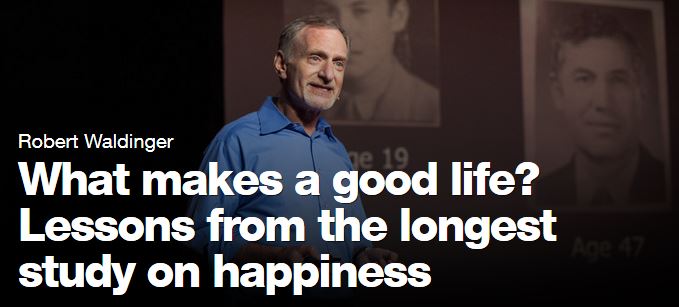
This afternoon I listened to a thirteen minute TED presentation by Robert Waldinger. His topic: What makes a good life? Lessons from the longest study on happiness. The findings were not earth-shaking, but they are interesting. For those of us living with a progressive neuromuscular disorder or any other chronic condition, the message is even more important.


“What keeps us happy and healthy as we go through life? If you think it's fame and money, you're not alone – but, according to psychiatrist Robert Waldinger, you're mistaken. As the director of 75-year-old study on adult development, Waldinger has unprecedented access to data on true happiness and satisfaction. In this talk, he shares three important lessons learned from the study as well as some practical, old-as-the-hills wisdom on how to build a fulfilling, long life.” 

If you prefer, there is also an interactive transcript. Give it a short and let me know what you think.

Saturday, April 11, 2015

Rules - I hate rules


Rules were always frustrating for me when I was young. I usually looked for ways to get around the rules. Sometimes I was successful and other times I failed. But it never stopped me from trying. As I have matured, rules tend to make me ponder something, i.e., consider their meaning when it applies to my life. 

My daughter posted this on her Facebook page yesterday. I’ve read similar ‘words of wisdom’, but this one is short, concise and on target. 


Yes, living with Kennedy’s Disease is a physical phenomenon. It is also a mental and emotional issue. Frustration, guilt, anger, fear and embarrassment are all part of the process leading toward acceptance. And, these ‘rules’ are about living a life filled with peace and happiness. 


  • Live in the present
  • Take no thought of what others think
  • Stop comparing what was to what is
  • Realize that you are responsible for your own happiness
  • And, most importantly, living with Kennedy’s Disease is not a death sentence. It is a new and different way of living a fulfilling and happy life.

Friday, December 7, 2012

What wealth cannot buy

I wrote this article in the ‘spirit that is Christmas'.

My wife and I were watching TV today. The program showed a celebrity taking his two daughters shopping in New York. Whatever the children wanted, their father bought. During the commercial, my wife asked, “When you were a child, did you ever wish to be rich?”

Xmas-spiritAfter considering her question for a few minutes, I answered, “Not that I can remember.” I then went on to explain that we never really thought about being lower middleclass. We had food on the table every day, clothes to wear summer and winter, and Christmas was always special because of our family traditions.

We discussed this topic for several minutes. Some of the reasons we came up with for not really considering what it would be like to have wealthy parents were:
  • All of our friends’ parents were similar in regards to occupations and income.
  • Family values and traditions were strong including daily family dinners, discussion times, family celebrations, and spiritual upbringing,
  • Strong friendships (both our parent’s friends and our friends).
  • And, resource sharing among friends.
There were several other things that made life special for each of us and not always ‘wanting’, but we settled in on two that were the most important.

1. Resource sharing made our lives pretty special.
  • A friend had a BB gun, we all were able to use it.
  • When another friend’s parents had a color television, we all spent time at his house watching our favorite programs.
  • Another friend’s parents had a house on a lake and a ski boat. We were always able to spend a little time each summer with them on the lake.
  • Our school (less than a block away) had basketball courts, a large grassed in area (that became our football field), and a baseball backstop and diamond. We had a lot of pickup games at the school.
  • A friend bought a car when he turned 15. We were all able to ride around town and to school by just coming up with a little gas money (usually a quarter because it would buy a gallon of gas). The only issue we ever had was who remembered to call out, “I’ve got shotgun” before anyone else.
  • My dad was part owner of a bus lines and he supplied the neighborhood kids with truck tire inner-tubes.  They were great for sliding down hills in the winter and floating on the lake in the summer.
2. Yet, my wife and I both agreed that family values and traditions were probably the strongest reasons.
  • Sitting down every evening as a family to eat dinner was important.
  • Being able to discuss issues, opportunities and plans always helped.
  • Family and friends getting together for birthdays, holidays, anniversaries, etc. always was special.
  • Celebrating Thanksgiving, Easter and Christmas with family and friends. These were always the special moments we remembered because these occasions brought great joy.
  • Our church brought us all together at least once a week. It was a moment to share common values and beliefs.
Xmas-hopeWe both agreed that our lives were much simpler because possessions were less important and family, friends, beliefs and traditions were the foundation of what made us happy.


Sunday, March 25, 2012

Happiness is a state of mind

happiness-is-in-your-handsIf you are a regular reader of my blog, you know the “Goodlife Zen” is one of my favorite blogs. Yesterday’s Goodlife Zen article was titled, “How to feel happier in 7 days or less.” It is a quick read and yet the concept Mary Jaksch discusses might just work.

Happiness is defined as:
  • A state of well-being characterized by emotions ranging from contentment to intense joy
  • A state of mind typically described as akin to pleasure, joy or enjoyment.
  • An active state of being, a choice, a state of mind, a goal, the end product of a fulfilling day.
  • On one level happiness is freedom from want and having the basic necessities of life. On another level, happiness consists of feelings of contentment, self-worth and well-being.
I especially like the last two definitions because I believe happiness is a choice. It also stems from a feeling of contentment and self-worth.

As those of us living with Kennedy’s Disease know, at times our self-esteem and self-worth can be challenged. When that happens, it is difficult to be ‘happy’ or ‘content’. So, I am always looking for ways to move beyond those feelings. In the blog article mentioned above, Mary asks you to do the following exercise for seven days.
  • Try completing this sentence each morning for seven days.

“To bring 5% more happiness to my life …”
  • What you write down is up to you.
  • Write what comes into your mind; don’t edit your thoughts. Don’t worry if you contradict yourself.
  • Write down at least six completions (answers) each time you use the technique.
I tried the exercise this morning and the results were interesting. I can see some benefits of using this exercise whenever you are feeling a little down or uncertain about what’s ahead. I like the ‘5%’ because you are not trying to change your world only trying to make it a little better. It causes you to focus on what would help change your current state of mind (attitude).

Thursday, November 3, 2011

Living a Full Life

If there is one piece of advice that I always give concerning living with Kennedy’s Disease, it is to not let the disease control your life.  It is important to find new ways to ‘live life to the fullest’.

Terry Waite’s guest post last week brought to mind an interesting article in Quest Magazine. Living Outside the Bubble by Debbie Button tells the story of a mother who has a child with SMA-1. The story is told from the perspective of a caregiver. While watching her son grow up, she tried to do everything to protect him and it was difficult to watch him become more assertive and self-reliant.

In the article, Ms. Button commented, “A door is never permanently locked; it just may require a new key.” This comment, along with Terry Waite’s skydiving experience, made me want to write this post.

Often I hear from men who have recently been diagnosed with Kennedy’s Disease who believe that their life has changed forever. They look upon the diagnoses almost like a death sentence. As Terry commented in his article, he needed to break free of his fears and get beyond “I can’t.”

triathlete In the past I have written about maintaining a “quality of life” that you, as well as your family, are comfortable with.  Many people with health issues refuse to give up and give in. Yes, they might not be able to physically perform certain things like they did a few years earlier, but there are ways around almost everything these days.  Finding a ‘new key’ is the trick.

For example, a blind man climbed Mt. Everest with the help ofsailing the rest of his team. Or, triathletes who compete in the IronMan without the use of their legs.  A KDA associate still sails every chance he can. Another associate in his 60s still plays golf every Saturday. A professor with Kennedy’s Disease took his class to Vietnam last year. The students had to carry him up and down steps and he had to rent a moped instead of a bicycle, but he still went everywhere and saw everything.

golf-1 Yes, they have help and use some aids, but they are still living the life they enjoy.

I still walk my dog four times a day and visit friends and neighbors with the help of my golf cart. I look for handicap accessible trails today where I can still use my wheelchair. Not that many years ago I was still hiking Mount Rainer. I fell down so many times while hiking that I lost count. Yet, I was back up there hiking again the next weekend. Every hike was special for my wife and I and we still talk about many of them today.  But, these hikes provided an even greater meaning for me.  I was still up there with my wife doing what we loved to do. 

Ms. Button ends her article with, “When navigating life with ahiking serious health situation, every day presents new and unique circumstances. But deciding to experience an abundant life will allow for the fewest regrets in the end. Fear is a natural response – but don’t let it keep you from moving forward.”
 

Yes, we have to adjust and we have to compensate, but that doesn’t mean we have to give in or give up.


  • What is your passion?
  • What do you love to do?
  • What is keeping you from doing it today?

 Now, find a way (a new key) so you can still enjoy it.

Sunday, September 25, 2011

Happiness is just a state of mind

Wikipedia defines “Happiness” as a mental state of well-being characterized by positive emotions ranging from contentment to intense joy.

happiness -3 Have you ever noticed that children are naturally happy.  And, a child’s laugh can make anyone, no matter what their age, laugh. 

What happens to that natural happiness as we age?  When did life become so serious that it could no longer be enjoyed?

The other day I was reading this article by Hannah Booth on some research performed in the United Kingdom. LSE professor Richard Layard and Dr. Anthony Seldon, aim to create positive social change. They have a movement called “Action for Happiness” with the core idea that we should try to create more happiness in our world.

The movement also developed a list of fifty activities that can help make positive changes in our lives. The activities include:
  • Do kind things for others
  • Look for the good in those around you
  • Get help if you are struggling
  • Help out someone in need
  • Try something new and different
  • Understand each other’s needs
  • Balance work and your social life
Ms. Booth decided to try some of the action steps to see how they would work in making her happier. The article reviews her attempts and the results.
  • Being Kind
Doing kind things for others strengthens our connection with them and builds trust ... particularly with strangers. These random acts of kindness lead to happier communities.  My daughter uses the term “pay it forward” (a great movie if you haven’t seen it).
  • Give Thanks
Write down every night at least three things you are grateful for that day.  By listing these things it can make you feel better almost immediately because they change our perception of how things went that day. Mark Williamson, the director at Action for Happiness, puts it this way. "It's not about ignoring bad things, but asking, did anything good happen today? You can usually find something."
  • Being Mindful
Relax a little and contemplate or meditate. Set aside time every day (as little as ten minutes) to just relax. Sit comfortably in a quiet area and focus on your breathing. Don’t try to shut out your thoughts, but just allow them to flow without focusing on anything except your breath. This can be especially powerful in a natural setting such as a park or your backyard. As you relax and let your thoughts flow, stress begins to dissipate from your body. After a few days, your perspective of life will change providing you with more energy and a sense of wellbeing.
  • Write a Letter
Write a letter thanking someone that you are grateful for. Once you have written the letter, read it to them. This experience will make both you and the person you are thankful for happy. According to Mr. Williamson, this effort also lets others know what they did that you value. And, if people know, then they are more likely to do it again. Ms. Booth was very uncomfortable initially reading the letter, but was amazed at the result ... immediate and later.
Happiness -2
The comment from Thoreau above is so true.  We cannot make ourselves happy just by wanting it to happen.  We have to first create a calm, loving and grateful environment.  Once this is achieved we will see the good that surrounds us.  

While reading this article, it brought to mind a couple of thoughts:
  1. The only handicap in life is a bad attitude.  Like happiness, attitude comes from within. 
  2. We create our own world by how we perceive it.  How I see events in my life decides how I will live my life.
I hope you have a happy day

Links:
Article Mentioned Above: Pursuit of Happiness
Action Steps: 50 Activities