Showing posts with label Taking care of yourself. Show all posts

Wednesday, May 29, 2019

Joint Participation in Improving your Health and Relationships


Below is another great post from Richard Wright. Its focus is on senior citizens and their caregivers using mindfulness meditation and yoga to improve their mental and physical health while participating in an activity they are both involved in. 

I have practiced mindfulness meditation for several years now. Every day, after my morning exercises and stretches, I will meditate. I’ll often meditate again in the early afternoon. Stretching, along with daily exercise is beneficial for all of us living with Kennedy’s Disease (SBMA). 

Many senior centers and YMCAs offer programs in stretching, yoga, and mindfulness meditation. For the self-starters, Richard has included links to sources on the internet that offer podcasts on these topics. 

Let me reemphasize the important side benefit of “participating together.” Living with any debilitating disorder is difficult for the individual as well as the caregiver. It can also be a rewarding experience, especially when activities are done together. Thank you, Richard.


This Is How Yoga and Meditation Can Transform the Lives of Seniors (And Their Caregivers)

Without proper stimulation and health-boosting activities, the lives of seniors and their caregivers can quickly become monotonous. There’s nothing wrong with having a routine, but it should include activities to get your blood flowing, improve strength, expand your mind, and relieve stress. You might be wondering how you’ll have time to achieve all those goals, but the good news is that yoga and meditation provide all of those things and more. In addition, they are activities the two of you can enjoy together or alone, which can help foster a healthy bond.


Yoga Offers Senior-Specific Benefits

When done safely and properly, yoga provides many wonderful benefits for seniors and caregivers alike. For starters, it can help strengthen bones to minimize, prevent, or slow the progression of osteoporosis, as well as keep your weight in check to prevent it from interfering with your mobility and desire for a more active lifestyle. Yoga is a low-impact exercise with a focus on slow, fluid movements, which can help seniors build strength and balance.


There are benefits for the mind, as well. Most styles of yoga include focused breathing and meditation, which can help seniors and caregivers keep their mind clear and sharp. Additionally, this practice can spike the brain's production of GABA, the chemical that keeps you calm and relaxed. Yoga requires instruction and guidance to keep you safe, so classes at your local yoga studio are the best place to start. However, if you’re looking to get a group of seniors together with a shared interest in yoga, try a senior meetup group.
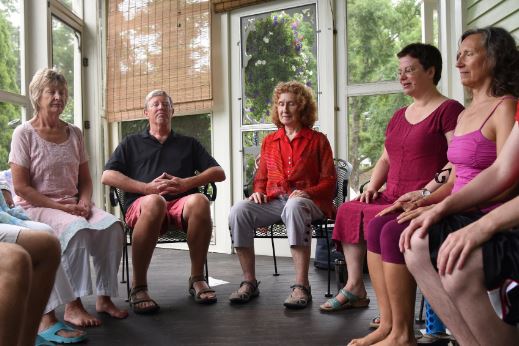

Meditation Can Stave Off Loneliness

Just like wrinkles and gray hair come with age, loneliness is common in seniors. Perhaps loved ones have passed away or children, family members, and friends no longer live close by. Loneliness has other impacts too. According to Psych Central, “loneliness is known to activate inflammatory genes which, in turn, are known to promote a variety of diseases” However, the study found that mindfulness meditation reduced feelings of loneliness in seniors via regular class attendance, and even reduced the genes that are markers for heart disease and inflammation. Meditation is an integral part of yoga, but it can be practiced on its own as well. There are several beginner podcasts online that will walk you through a meditation session.

Commit to the Practice

Yoga and meditation require dedication and consistent practice. There will be some days when getting to a class isn’t possible, or perhaps you’d just like to be able to practice at home once you learn the proper technique. To achieve this, you’ll need to clear out a room to give you enough space to safely and comfortably practice. It is best to create a dedicatedspace, as you’ll likely grow tired of having to move around furniture and items every time you want to practice. If need be, move some of your belongings into storage to free up space. Incorporate soothing sounds, scents, colors, and lighting for a truly zen experience.

Safety Comes First

Whether you are practicing yoga, meditation, or both, safety should always be your top priority. Yoga is appropriate for all ages, but seniors will benefit from gentle classes such as Iyengar, Viniyoga, and Kripalu. Most yoga studios offer gentle/beginner classes and can help you adapt the poses using chairs and props. As the caregiver, it is your job to communicate with the instructor about the needs and abilities of your senior loved one. This includes disclosing physical and mental ailments, as well as their mood for the day.

Life can be difficult at times for both seniors and caregivers. For this very reason, self-care is crucial. Yoga and meditation combine physical and mental health benefits for a relaxing activity the two of you can explore together.
Photo Credits:

Sunday, April 1, 2018

Who’s Driving the Bus?

I believe there are choices in life that have to be made. I am not talking about simple, easy choices (like what should I eat for dinner). I am talking about “life changing” choices. Often these choices are not always evident. Some have to be discovered before they can be made. It is important that we do not close the book on ourselves because of your situation

I know I keep repeating this, but it is important. Kennedy’s Disease is a slowly progressing disorder. It is often ten or twenty years between the time of onset and our first real life-changing issues. During that time, we have the opportunity to make several choices. As the severity of the condition increases, even more choices will have to be made. We cannot just shut down. We have to recognize the choices and opportunities available, and decide what is best for us.

For those of us living with Kennedy’s Disease, the minute we give up the steering wheel (stop fighting, stop exercising, or lose hope), we become a passenger and no longer have a say as to where we are going and how we get there.

For me, I am a ‘man’ and I still like driving. I also like to know where I am going. I might not always stop and ask for directions, but that does not mean I am lost. 😜


I have a saying, "A bad attitude is the only handicap in life." What I mean by that is we can never give up hope. We have to believe there is a light at the end of the tunnel. We cannot give up on ourselves because of our current situation or fears of what might happen in the future. When we do, we no longer have any choices and someone else will make the decisions for us. 


In other words, you have to be your own advocate for your physical, mental, emotional and spiritual health. I also believe that those of us living with this condition need a good co-pilot. Our spouse, significant other, soul mate, or best friend becomes a critical element in our future success. She or he needs to be involved in the decision-making process. A partnership in the truest sense is needed because we cannot always see the forest because of the trees.

So, I will ask again, who’s driving the bus?


Bus Photo: https://www.maxim.com/tag/vw-bus
Quote: https://quotlr.com/

Monday, March 16, 2015

Make friends with good habits – no, not Hobbits


Zen Habits has an article this week on adding more discipline into your life.
By Leo Babauta
What do you do if your life is a mess, you have no discipline or routines, can’t stick to anything, procrastinate, and feel out of control?

How do you get started with the discipline habit when you have so much to change?
You start by washing your dishes.

It’s just one small step: when you eat your cereal, wash your bowl and spoon. When you finish drinking coffee or tea, wash your cup. Don’t leave dishes in the sink or counter or table.
Mindfully wash your dish, right away.

Form this habit one dish at a time, one day at a time. Once you do this for a few weeks, you can start making sure the sink is clean. Then the counter. Then put your clothes away when you take them off. Then start doing a few pushups. Eat a few vegetables.

One of these at a time, you’ll start to build the discipline habit and trust yourself to stick to something.

But for now, just wash your dishes.

While reading the article, I thought back on the times someone mentioned to me that they are not as disciplined as I am. They wished they could find the time to exercise regularly … or meditate or whatever.

My standard response is, “If I didn’t believe it helped, I probably wouldn’t do it.” I find it easier to maintain a habit when I see or feel results. In the case of exercising every day, I see and feel the results. When it comes to eating a large salad every day, I feel the results. 

Just as important, I find it easier to change a negative habit when I can see or feel the results. For example, I quit smoking over 40 years ago because I saw and felt the negative aspects of what smoking three packs a day had upon my life and my family. I quit ‘one cigarette at a time’. 

Now, when you initially start changing a habit, you will not see or feel the beneficial results. At that point, you are working on faith. You believe that the change will be positive in some way. For example, last summer I gave up eating ice cream every day. It was a habit I had been indulging in for close to 50 years. My belief was that I would generate less phlegm by eliminating this milk product from my diet. Now, I didn’t initially say, “I will never eat ice cream again.”  I told myself each time I wanted ice cream that I would wait an hour and if I still wanted it then, I would have a bowl.” Guess what? In an hour I was doing something else and didn’t even think about it. It has been nine months and I see and feel the difference. Today, I still don’t tell myself that I will never eat ice cream again. When I think about it (“Um, that sounds good”), I just wait an hour.

Saturday, August 11, 2012

Take care of yourself

The blog article titled “What you owe your loved ones” has several key points. I wrote about “arranging your affairs” last week. This week I want to address another topic from the article.

taking care-feetTaking care of yourself is a responsibility. You take care of yourself to minimize the stress and concern of your loved ones. For those of use living with Kennedy’s Disease, we learn early on in the progression that we are ‘high maintenance’. And, most of the stress we cause our loved ones is because of our falls and because we try to do something we shouldn’t be doing in the first place. Far too often we let our ego or our stubbornness get in the way of good sense.

Several of my bad falls (sprains, broken bones or concussions) were the result of me not thinking of the worst case scenarios before attempting something. Today, I would like to think that I consider most of the possibilities before starting something. Occasionally, I still miss a scenario. The only reason I know I missed one is because it happens.

Enjoy the topic below and follow the link above to read the entire article.
____________________________ 

In order to be there for your loved ones you need to be the best person you can be. 

Taking care of yourself means:
  • You make it a priority to rest and get enough sleep every night.
  • You exercise regularly and eat the healthiest foods you can afford.
  • You give yourself time alone to meditate or reflect and renew if and when you need to.
  • You allow yourself to work on projects you’re passionate about and have as much fun as you can.
  • You foster relationships with the people you care about and respect.
These are the basic steps but you can add anything that energizes you and enhances your inner and physical wellbeing.
_____________________________ 

Now, since you know I am an exercise addict and have realized the benefits of exercise in maintaining my strength, I need to reemphasize the number two bullet:
  • You exercise regularly performing ‘smart’ exercises that improve and maintain your strength, flexibility and general health.
And, even though it is insinuated in the last bullet in the article above, I feel it is important to add:
  • You are ‘open’ and ‘honest’ with your loved ones. You keep them informed and share your feelings including your fears. This open and honest relationship nurtures the relationships of those you love. It also frees you from wallowing in your own negative emotions that can lead to depression.
The key message is to show your love to others by taking care of yourself.
taking care-love